
A novel type of three-dimensional (3D) polar topological structure, termed the "polar chiral bobber," has been discovered in ferroelectric oxide thin films, demonstrating promising potential for high-density multistate non-volatile memory and logic devices.
The breakthrough was achieved by a collaborative research team from the Institute of Metal Research (IMR) of the Chinese Academy of Sciences, the Songshan Lake Materials Laboratory, and other institutions. The findings were published in Advanced Materials on January 30.
Topological polar textures in ferroelectrics, such as flux-closures, vortices, skyrmions, merons, Bloch points, and high-order radial vortices discovered in recent years, have attracted wide interest for future electronic applications. However, most known polar states possess limited configurational degrees of freedom, constraining their potential for multilevel data storage.
In this study, the researchers used phase-field simulations and aberration-corrected transmission electron microscopy to predict and experimentally confirm the existence of polar chiral bobbers in (111)-oriented ultrathin PbTiO₃ ferroelectric films. This 3D topological structure is characterized by a nanoscale domain with out-of-plane polarization opposite to its surroundings, which starts from the film surface and terminates at a Bloch point inside the film. Around this core, an in-plane vortex-like polarization distribution forms, resembling the "bobber" texture previously observed in magnetic systems. The combination of the in-plane vortex and the out-of-plane polarization endows the bobber with chirality.
Each polar bobber can exhibit up to eight distinct topological states, determined by the combinations of in-plane polarization rotation (clockwise or counterclockwise), out-of-plane polarization direction (up or down), and its location relative to the film surface (top or bottom). All eight states show robust stability under identical external conditions, breaking the traditional binary (0/1) coding limitation in ferroelectric memory and offering a new physical basis for high-density multistate storage.
Phase-field simulations further reveal that the polar bobber emerges from the competition among multiple variant domains under the constraints of epitaxial strain and electrical boundary conditions, and is stabilized by electrostatic interactions. The calculations also suggest that reversible switching between different bobber states can be achieved with low-energy electric fields, highlighting promising prospects for device applications.
This work not only expands the family of three-dimensional polar topological structures but also systematically demonstrates a topological entity capable of multistate encoding in ferroelectrics. It provides an important physical foundation and design strategy for next-generation electronic devices.
Additionally, the study underscores the critical role of orientation engineering, strain tuning, and atomic-resolution electron microscopy in discovering and understanding novel ferroelectric topological states.
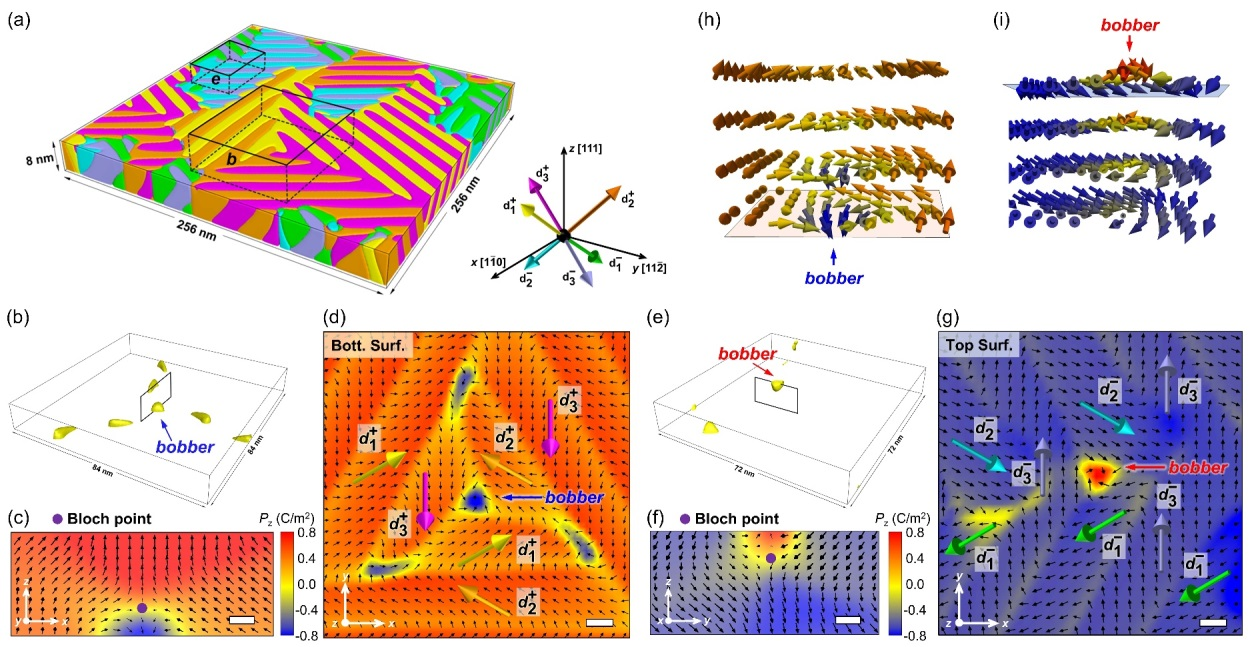
Phase-field simulation predicts the emergence of polar chiral bobbers in (111)-oriented ultrathin PbTiO₃ ferroelectric films and reveals their polarization characteristics. (Image by IMR)
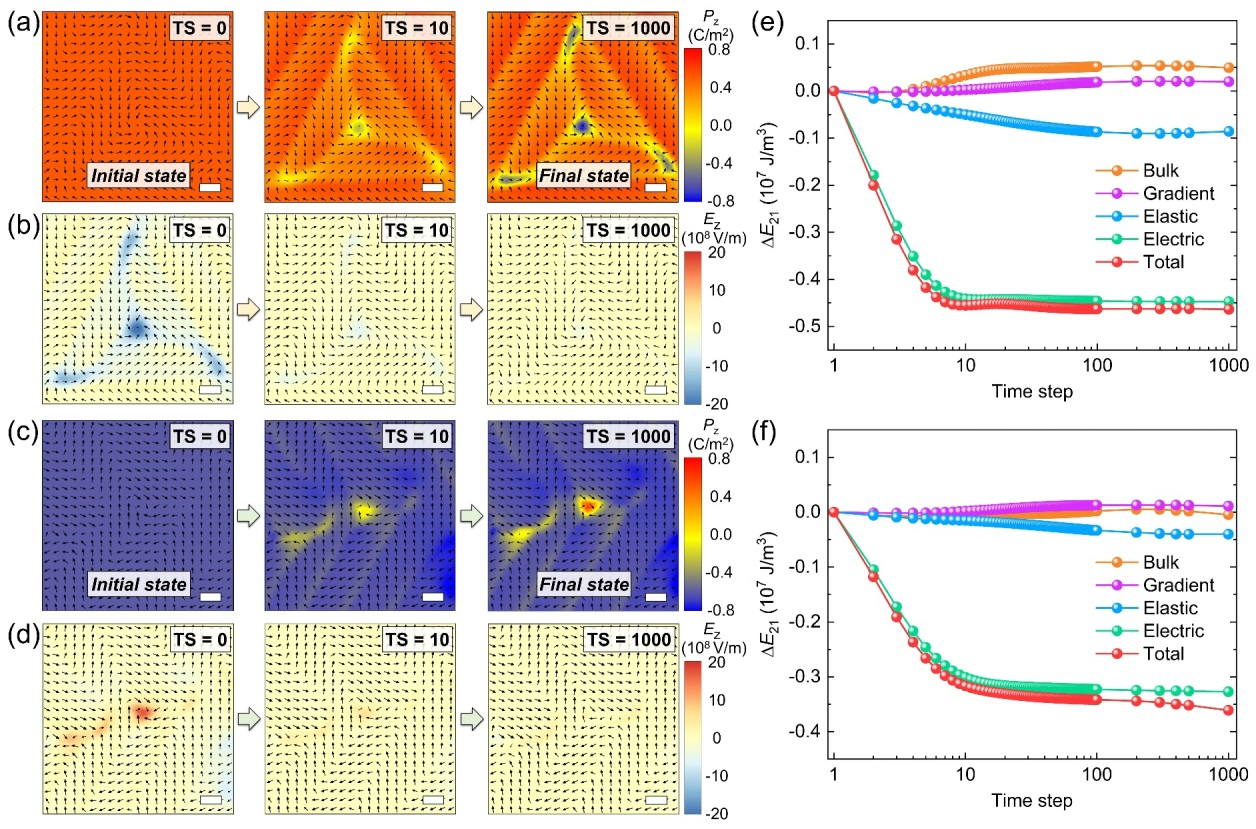
Analysis of the energy-driven mechanism for the formation of polar chiral bobbers. (Image by IMR)

Aberration-corrected transmission electron microscopy analysis of the polarization structure of a polar chiral bobber. (Image by IMR)
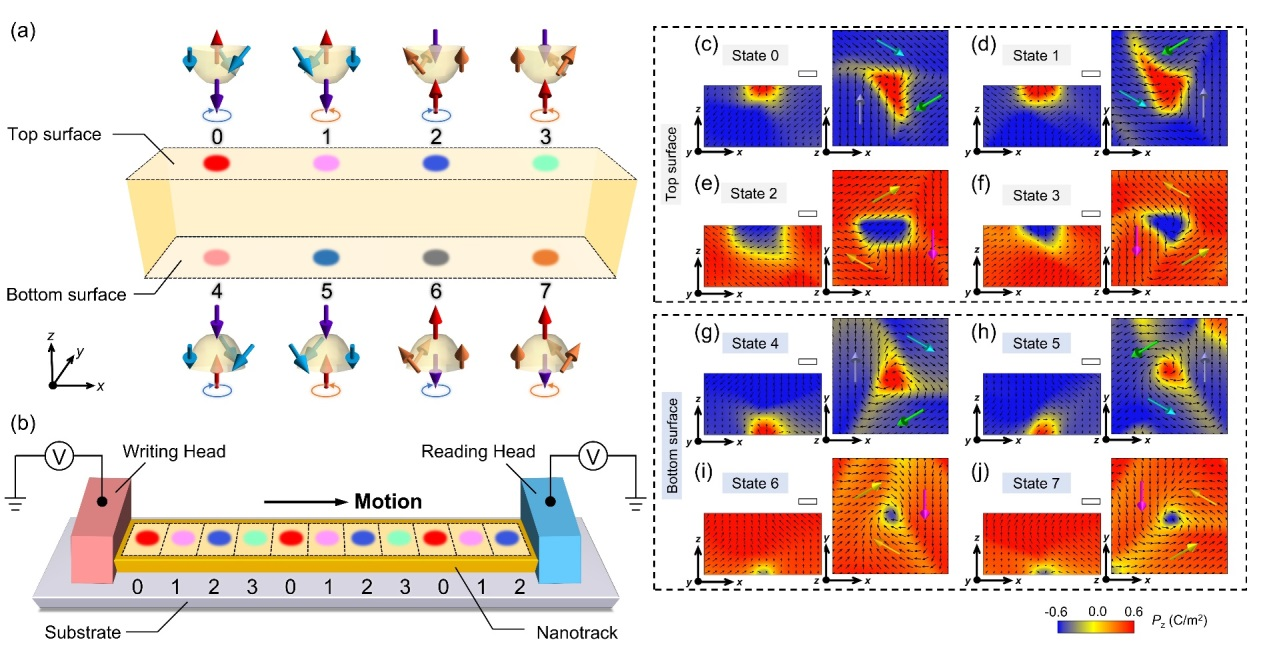
Schematic diagrams of multistate polar chiral bobbers and their application in multistate information storage. (Image by IMR)

Electric-field-driven reversible switching between different polar chiral bobber topological states. (Image by IMR)

86-10-68597521 (day)
86-10-68597289 (night)

52 Sanlihe Rd., Xicheng District,
Beijing, China (100864)
Copyright © 2002 - Chinese Academy of Sciences


